
24/7 Customer Care
(312) 767-3227
What Is Drayage? The Complete Guide for Trade Show Exhibitors

Drayage is, consistently, the most complained-about cost in trade show exhibiting. It's also the least understood. Exhibitors see the invoice after the show and question every line.The numbers don't seem to add up. And yet the charges keep coming. This guide explains exactly what drayage is, how it's calculated, why it costs what it does — and how to keep your bill from being higher than it needs to be.
What Is Drayage, Exactly?
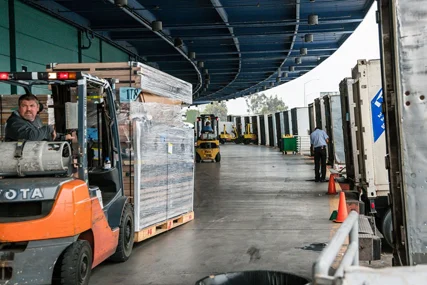
In trade show terms, drayage — also called material handling —refers to the movement of your exhibit freight from the shipping dock or advance warehouse to your booth space, and back to the loading dock at the close of the show. It's a round-trip service: in at move-in, out at move-out.
The service is provided exclusively by the show's general service contractor (GSC). Unlike your freight carrier — which you choose freely— the GSC is the only company authorized to move materials on the show floor.This exclusivity is why drayage costs are non-negotiable and why the rates can feel significant relative to the short distance involved.
The full drayage service typically includes: unloading your freight from the carrier at the dock, transporting it to your booth space, removing empty crates and storing them during the show, returning empty cratesat dismantle, and loading outbound freight onto your carrier at move-out.
How Is Drayage Calculated?
Drayage is billed by hundred weight — referred to as CWT (from the Latin centum, meaning 100). Every 100 pounds of freight is one CWT. The GSC publishes a rate per CWT in the show's exhibitor services manual, and that rate is applied to the total weight of your inbound freight.
Example Calculation: Your exhibit weighs 1,450 lbs. The show's drayage rate is $90/CWT. 1,450 ÷ 100 = 14.5 CWT, rounded up to 15 CWT. 15 × $90 = $1,350 in base drayage. Then add any applicable surcharges.
Important: weight is always rounded up to the next 100 pounds. A 201-pound shipment is billed as 300 pounds. A 2 CWT minimum is standard — meaning even a single small box incurs the charge as if it weighed 200 lbs.
What Factors Affect Your Drayage Rate?
The base CWT rate is just the starting point. Several factors can increase the final bill significantly:
- Advance vs. showsite delivery: Advance warehouse shipments typically carry a higher CWT rate — often 25–30% more — because the freight is handled an extra time.
- Crated vs. uncrated freight: Crated freight has the lowest CWT rate. Uncrated or blanket-wrapped freight can carry surcharges of 35–55% above the base rate due to the additional labor required.
- Special handling: Oversized pieces, tech-heavy displays, and freight requiring unusual equipment or extra personnel trigger special handling fees on top of the base rate.
- Overtime surcharges: Freight received or moved outside standard show hours — evenings, weekends, overtime periods — incurs premium labor rates. Missing your targeted move-in window is the most common cause.
- Off-target delivery: If your freight arrives outside the window assigned for your booth location, it gets processed after all on-target shipments. Off-target freight almost always incurs overtime charges.
- Small shipment minimums: Most shows charge a 2 CWT minimum per shipment. Multiple small packages shipped separately can each trigger this minimum independently.
Why Does Drayage Cost So Much?
It's a fair question. The distance from the loading dock to your booth might be 200 feet. The charge might be $1,500. The gap between those two facts is what frustrates exhibitors — and understandably so.
The cost is driven by unionized labor at most major convention centers. The GSC is required to use union workers for all freight movement on the show floor, and union labor rates in cities like Las Vegas, Chicago, and Orlando are substantial. The GSC also incurs significant overhead costs:r enting marshalling yard space, operating forklifts and equipment, managing billing for thousands of exhibitors, and staffing the service desk throughout the show.
None of this makes drayage feel less expensive. But understanding what drives the cost helps you focus on the variables you can control — because the rate itself is set before the show and cannot be negotiated.
How to Keep Your Drayage Bill Under Control
- Ship to the advance warehouse (for large shows). Despite the higher CWT rate, avoiding overtime exposure at a large show's marshalling yard often results in lower total drayage.
- Use crates, not blanket wrap. Crated freight carries the lowest drayage rate. If your exhibit usesblanket-wrap shipping, consider whether the material handling savings fromswitching to crates justify the cost of crating.
- Consolidate all shipments. Never send multiple small packages separately. Consolidate everything onto a single pallet or into a single crate to minimize per-shipment minimums.
- Hit your targeted move-in window. This is the single most impactful thing you can do. Off-target delivery + overtime = a drayage bill that can be 50% higher than anticipated.
- Review the exhibitor kit & quick facts carefully. Every show publishes its drayage rates and surcharge structure inthe exhibitor services manual. Read it before your freight ships — not after the invoice arrives.
- Work with a show-specific freight partner. Carriers experienced in trade show logistics understand targeted windows, documentation requirements, and marshalling yard procedures — the factors that determine whether you hit your window or miss it.
The Bottom Line
Drayage is unavoidable. But an unexpectedly large drayage bill usually isn't — it's the result of missed windows, improperly packaged freight, incorrect documentation, or a carrier who didn't know what they were walking into. The best drayage strategy is a good freight strategy: ship correctly, on time, with accurate paperwork, through a partner who knows how the show floorworks.
More from Exhibitway
More From exhibitway Logistics

The freight partner
built for trade shows.